
For years, one question has continued to come up in the textile industry:
Can natural dyes really work in modern textile production at bulk scale?
Coloring a small piece of yarn or fabric with a natural dye is one thing. Getting the same color, evenly and repeatedly, through an industrial dyeing machine is something else entirely.
At production scale, natural dyeing has to meet the same practical demands as any other textile process: consistency, reproducibility, acceptable fastness, manageable processing times and, above all, the ability to repeat the process from one batch to the next.
For knitted fabrics, the challenge becomes even more demanding. Soft-flow machines are designed to move delicate knitted fabric continuously through the dye liquor. Any imbalance in circulation, application or dye distribution can quickly show up as streaks, unevenness or shade variation.
So, can natural color work in a soft-flow machine?
After two years of trials in Tirupur, we believe the answer is increasingly becoming yes.
But getting there has required much more than simply putting a natural dye into an industrial machine.
From Natural Color to Industrial Process
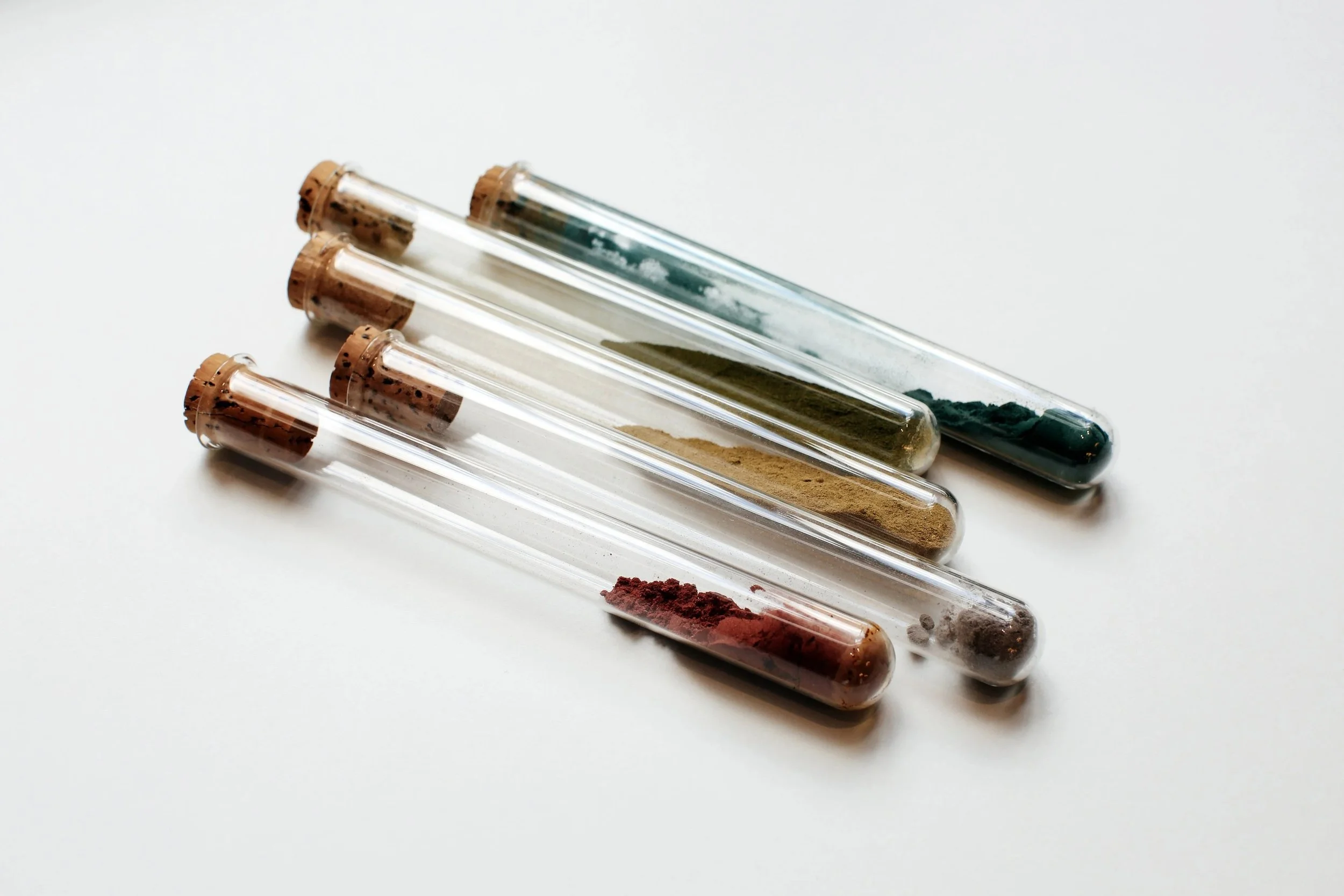
Natural dyes have been used on textiles for centuries. Over the last few decades, designers, artists, researchers and textile studios—including people such as Ria Burns and India Flint—have helped expand our understanding of botanical colors, dye plants, extraction and their application to natural fibers.
Much of this work has demonstrated the beauty and potential of natural color.
But demonstrating that a natural dye can color a knitted textile is very different from developing a repeatable industrial process for bulk production.
A laboratory recipe may work beautifully on a small piece of fabric. Once the same process is moved into an industrial machine, however, completely different variables come into play.
The question is no longer simply:
“Can this dye produce this color?”
It becomes:
“Can this color be produced consistently, efficiently and reliably on every batch?”
That distinction has been at the heart of our work.
Two Years of Solving Practical Problems
For the past two years, our team has been working on natural dyeing of knitted fabrics in soft-flow machines.
The objective was not simply to prove that natural dyes could produce a shade.
We wanted to address the practical problems a dyehouse would encounter when trying to introduce natural dyes into regular production.
How should the dye be introduced into the machine?
How can streaking be minimized?
Can a natural dye paste work effectively with the circulation and spray system of a soft-flow machine?
How can shade consistency be improved?
What level of fastness can realistically be achieved?
And perhaps most importantly, how can the process be made simple enough for existing textile manufacturers to adopt?
These were not questions that could be answered entirely in a laboratory.
They had to be tested on the machine itself, repeatedly.
Why Tirupur Was the Right Place to Test It

The development work was carried out in Tirupur with the support of the young and dynamic team at Avuri Natural Dyeing and Herbal Dyeing.
Tirupur is one of India's major knitwear production centers. Its concentration of textile manufacturers, dyehouses and garment businesses makes it an especially valuable environment for developing practical solutions for knitted fabrics.
Here, the focus was not theoretical.
Every trial had to answer a production question.
Across multiple trials, we worked simultaneously on the natural dye formulation and on how that formulation was introduced and distributed inside the machine.
That combination proved to be critical.
Developing a Natural Dye System for Soft-Flow Machines
One of the important developments from this work was a special spray system designed around the behavior of our natural dye formulation.
This is important because natural dye extracts do not necessarily behave like conventional synthetic dyes.
Their physical characteristics can be different, which means that simply replacing a synthetic dye with a natural extract in an existing industrial process does not automatically produce a satisfactory result.
The dye itself has to be considered.
As part of our trials, the natural dye was developed into a special paste formulation suitable for soft-flow processing. At the same time, the spray and application system were developed to work with that formulation.
The two developments were therefore treated as parts of the same process rather than as separate problems.
We were not trying to force a traditional natural dye recipe into an industrial machine.
We were developing a natural dye system specifically for industrial soft-flow processing.
What Have We Achieved So Far?
After two years of continuous trials, the results have been encouraging.
Depending on the shade and application, our trials have achieved approximately 3–4 level fastness.
More importantly, we have been able to achieve almost streak-free dyeing on knitted fabrics.
We have also successfully worked with batches of around 20 kg, developing approximately 10 different shades through the process.
For us, this represents an important step.
It suggests that natural dyeing of knitted fabrics in soft-flow machines does not necessarily have to remain limited to laboratory experiments, small-batch dyeing or artisanal applications.
It can be developed into a practical production process.
At the same time, 20 kg is not the finish line.
It is a starting point for the next stage of scale-up.
Why Scaling Natural Dyeing Is Not as Simple as Scaling a Recipe
One of the biggest misconceptions about industrial natural dyeing is that a recipe that works at a small scale can simply be multiplied to work at a larger scale.
In practice, scale-up is much more complicated.
A process that works on 100 grams of fabric can behave very differently at 20 kg—or eventually at 200 kg.
The amount of dye liquor changes.
Fabric circulation changes.
Heat transfer changes.
Dye distribution changes.
The interaction between the formulation and the machine changes.
Even seemingly small differences in process conditions can influence the final shade and levelness.
This is why we believe that industrial natural dyeing requires process engineering, not just recipe scaling.
The Variables That Matter in Soft-Flow Natural Dyeing
A successful natural dyeing process depends on several elements working together.
These include:
Natural dye formulation
Dye concentration
Paste viscosity and stability
Filtration
Spray and application system
Liquor ratio
Fabric circulation
Temperature profile
Dyeing time
pH
Washing and after-treatment
Fiber and fabric construction
None of these factors exists in isolation.
A change in one can affect the behavior of the others.
That is why industrial natural dyeing has to be viewed as a complete system involving the dye, fiber, fabric, machine and process.
Why Soft-Flow Machines Are Particularly Interesting for Knits
Knitted fabrics require careful handling because of their construction and sensitivity to mechanical stress.
Soft-flow machines are designed to provide comparatively gentle fabric movement while allowing the fabric to circulate through the dye liquor.
That makes them an interesting platform for exploring industrial natural dyeing of knitted fabrics.
But the machine itself is only part of the solution.
A soft-flow machine cannot compensate for a dye formulation that does not behave properly within the system, nor can a good formulation automatically guarantee level dyeing without the right application and process conditions.
The machine, dye and process have to work together.
Making Natural Dyes Easier for Industry
Natural dyeing is sometimes viewed as slow, complicated and difficult to reproduce.
There are genuine challenges behind that perception.
But those challenges do not necessarily mean that natural dyes have to remain outside mainstream industrial production.
The industry needs to move beyond simply supplying natural extracts or traditional dye recipes.
What is needed is the development of complete natural dye application systems.
That means understanding:
The dye.
The fiber.
The fabric.
The machine.
The process.
If a manufacturer has to completely redesign its production infrastructure before it can use natural dyes, adoption will naturally remain difficult.
A more practical approach is to develop natural dye systems that can work with existing industrial infrastructure wherever possible.
That is the direction we are pursuing.
What Comes Next?
We are not claiming that the problem is solved.
It isn't.
The next stage is to take the process into substantially larger batch sizes and understand how consistently it performs at greater production volumes.
There are also several areas that need continued evaluation.
These include:
Development of additional shades
Fastness across different applications
Larger batch consistency
Production economics
Water consumption
Energy consumption
Wastewater considerations
Process controls for industrial production
And there is another important point: every natural dye behaves differently.
A process developed for one natural color cannot automatically be assumed to work identically for another.
This is why continued machine-level trials remain important.
From “Is It Possible?” to “How Far Can We Take It?”
Perhaps the biggest change over these two years is the question itself.
At the beginning, the question was:
“Is natural dyeing possible in a soft-flow machine?”
Today, after repeated trials, a more interesting question is emerging:
“How far can we take it?”
That is a very different place to be.
We have demonstrated encouraging results at around 20 kg, with approximately 10 shades and almost streak-free dyeing in our trials. The next step is to understand what happens as the batch size increases and the process moves closer to the demands of regular industrial production.
There is still a lot to learn.
But that is precisely what makes the next stage exciting.
The Future of Natural Color in Knitwear
The goal is not to take textile manufacturing backwards.
It is to take what we know about natural color and combine it with modern textile technology.
For natural dyes to become more relevant to industrial knitwear production, they need to be more than beautiful colors. They need to become technically reliable, repeatable and practical for manufacturers.
That requires collaboration between dye developers, textile processors, machine operators, manufacturers and researchers.
Our two-year journey in Tirupur has shown us that the conversation can move beyond whether natural dyes can work in industrial machines.
They can.
The real work now is understanding how consistently, economically and efficiently we can scale that process.
The next batch will tell us how far we can go.
